Tuesday, May 3, 2016

Lahinch and the Cliffs of Moher


After leaving the somewhat treacherous Conor Pass, we continued on the Wild Atlantic Way towards the ferry that would take us from County Kerry to County Clare, and to Lahinch where we would be spending the next two nights.

We really had not planned to take the Killimer-Tarbert Car Ferry, but a local in Dingle told us that driving all the way to Limerick was a waste of time.  So glad we followed his advice!  The ferry route was much shorter, and was so pretty.


When we arrived in Lahinch, we soon realized that the directions we had to our next accommodation, Callura Cottage, were assuming that we were coming from the opposite direction.   Our wonderful, wonderful, wonderful hostess (and cottage owner), Mary, had emailed us that if we got lost to just pull in at the Atlantic Hotel and ask for directions.  It turns out that her son worked there, and he was the very person we talked to!  He said, "Oh yeah.  That's me mam!  I'll call her."  Mary drove into town and met us, and we followed her back to the cottage.  She and her daughter were there preparing for our stay, so after making sure we knew how to find our way back and that we knew where to find the key, she directed us to the Cliffs of Moher, our next sight-seeing destination.


The Cliffs of Moher

The Cliffs of Moher and The Rock of Cashel are tied for the coldest two places I have ever been!  The wind was whipping and knocking us about as soon as we got out of the car, and I thought that it would surely blow us over the cliffs!  But what magnificent views!  The Cliffs are Ireland's most visited attraction, and we were thrilled to be among the 1 million people who visit each year.  On this particular day, it wasn't very crowded at all, in part I'm sure because of the weather, which included high winds, very cold temperatures, and HAIL!


That's O'Brien's Tower in the distance.  We didn't climb up.

We walked in both directions from the Visitor's Center, and I chose to stay on the designated paths and behind the guard rails.  Many people absolutely did not.   While I'm sure that it is very exciting to stand or sit on the cliffs edge for a photo op, it just wasn't worth it to me.


We left the cliffs and traveled on our way, hoping to explore The Burren.  We weren't entirely successful, but we did see a beautiful rainbow!


Double rainbow!

We did find the edges of The Burren, but knew that we were not exactly at the right place.  And as the sun started to set, we realized that we needed to return to our cottage while it was still light enough to find our way.


Callura Cottage

 
We LOVE our cottage!  Callura Cottage  sits on a hill, with views of the ocean on one side and beautiful pastures on the other.  We returned, maybe with a chocolate muffin or two, and settled in to relax for the evening.  When we walked in the cottage from our cold day out exploring, we found that Mary had left a roaring peat fire in the fireplace, towels warming on the heat vents, and homemade scones waiting in the kitchen.   We loved her Irish hospitality!
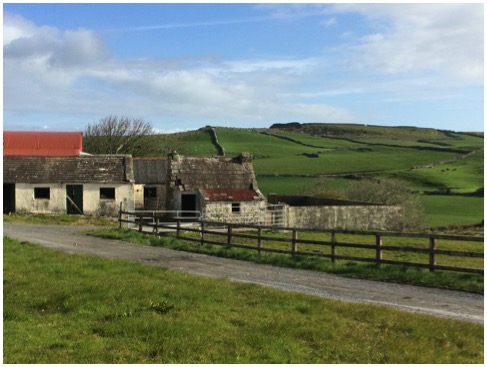

These are the views from our cottage!  It's so beautiful!  The inside is beautiful as well.  Mary came back and visited with us, at our invitation, and told us the history of the house. 


We are SO very happy to be here.


Monday, May 2, 2016

Dingle Town

Yesterday was our very first day of bad weather, and it wasn't that bad--just extremely DREARY.  We couldn't even tell where the water ended and the sky began.  But after beginning our day with a cheery fire, cheese toast and lattes, we left to explore Dingle Town, stopping at the Famine Cottages on the way.

Slea Head Famine Cottages

 
For the generations of families who lived in The Famine Cottages life was very hard, especially during the Famine years. One story tells that during the mid- to late-1800s, the family living here had six of their children die at birth, possibly because of the poor health and living condition of the time.  Nobody really knows.  Because the children had not been baptized before death, the Catholic church would not allow them to be buried in a graveyard of the church. The parents had no choice but to bury all six children on their own land. They were all laid to rest just a few hundred yards from the cottage, and a simple stone cross marks their grave.

The potato famine took place in the mid-1800s, when a blight killed all the potatoes for several consecutive years.  Irish tenant farmers struggled to provide for their families, and at the same time provide the land owners and the British government with a cash crop.  When crops failed, many land owners evicted their tenants, and the British government did little or nothing to alleviate the pain and suffering of the Irish farmers and their families.  The people of western Ireland were especially affected.  Many died, and many emigrated to other countries.  I had always heard about the Great Famine in Ireland, but I didn't understand the horrors of it.  I'm sure that I still don't fully understand, but my eyes were certainly opened.


Dingle Town

This was a bank holiday weekend, and we headed into Dingle Town to celebrate.  We were delighted to find a Feile na Bealtaine, or May Festival, in progress, complete with a parade of school children depicting famous artists.  So much fun!


We celebrated with a "chocolate biscuit" from the Farmer's Market (the Farmer's Market which turned out to be four food booths--maybe five).

After walking around town in the cold drizzle, and ducking into a few shops, we were ready to warm up with lunch at Murphy's Pub.  Hot chowder, toasted sandwiches, and chips (fries) hit the spot.

And THEN we went to Murphy's  Ice Cream (not the same as the pub) to sample their famous ice cream.  I had brown soda bread ice cream, which I heartily recommend!  All of the ice cream is made right there in Dingle with all Irish ingredients.

While it seems that all we did was eat, we LOVED exploring this little town so full of charm.  It was the perfect way to spend such a cloudy, dreary day.


The sun came out just a little bit on our way back to the farmhouse, and we stopped at the beach in Ventry.  So beautiful. 


When we planned our trip, we knew that Dingle would be our half-way point, and that we would probably want to rest and relax some.  So on our last night on the Dingle Peninsula, we settled in at our farmhouse, ate carry-out pizza, and did just that.


This morning we left our wonderful Dingle Farmhouse and headed towards Lahinch, where we would spend the next two nights.  Because we have eaten at so many fabulous pubs, cafes and restaurants, I thought I would mention our breakfast.

We ate in the grocery store in Dingle Town!  And it was good!

And then we traveled over the Conor Pass.  Oh my.   According to one account I read, it "offers to drivers the breathtaking, cliff hanging experience of navigating through Ireland's highest mountain pass, in a road tight and precarious, weaving its way around the sharp cliff faces."  And it was rainy.  And yes, this is for two-way traffic!  This was taken through the windshield, but you get the picture (literally).


A little bit of sun peaked through the clouds though, and the views truly were breathtaking.


As beautiful as the Conor Pass was, I was relieved when we reached the end!

On to our next destination - County Clare!


Saturday, April 30, 2016

The Dingle Peninsula

So much to see.  So little time!  We left our farmhouse for the day to explore the Slea Head Scenic Route.

Prehistoric Beehive Huts

Our first stop was at the Prehistoric Beehive Huts.  According to what we learned, these were probably once single family dwellings.  They were built in a circle, with each layer of stone placed a little closer to the center than the one under it, until there was just a small opening at the top that could be closed with one stone.  No mortar was using in building these huts (called corbelling).  It's hard to say how old they are, because corbelling was used as long ago as 3100 B.C. and as recently as the 1950s!  The huts on Slea Head Drive were probably built in the 12th century, when the Irish people were pushed off the good land out to the edges of the Dingle Peninsula.


Ryan's Daughter Beach

Next stop - the beach where parts of Ryan's Daughter were filmed!  Have you watched the move?  I loved it!  I watched it before our trip, and was very excited about seeing some of the places used in the filming.  We looked for the schoolhouse where Robert Mitchum (as Charles Shaughnessy) taught and lived, but we couldn't find it.  Either it has been torn down, or we drove by it without recognizing it.


                                   Don't do it Art!                                  Denise and Art are making a cairn of their own.


Dunquin (DĂșn Chaoin) Pier

I had seen this pier in so many pictures before we visited Ireland, and was excited to visit it in person.   We walked down the steep path to the pier, where the ferry leaves to take visitors to the Blasket Islands.


Gallarus Oratory

This tiny church was built around the 7th or 8th century, and resembles an upside-down boat.  It was built and used by local farmers, and is made only of local stones fitted together with no mortar.  It has remained waterproof and in near-perfect condition, and has not been restored because it has not needed it.  It has withstood the elements for over 1200 years!


Kilmalkedar Church Ruins

Kilmalkedar is a medieval early-Christian site known for its 12th century Romanesque church and several interesting artifacts such as an alphabet stone, sundial, large stone cross, and Ogham stone.  I didn't get a picture of it, but the Ogham stone at this church has a hole in it, and it supposedly was used to make deals.  If you touched fingers through the hole in the stone (which was over a grave) the deal would be binding until death.  (Maybe like swearing on your relative's grave?)

The stone cross in front of the church

                                 Tim is examining the sundial.             Beautiful Romanesque doorway

Across the dirt road from the church is St. Brendan's House, or the Priest's House.  I really wanted to explore it, but a locked gate blocked the entrance.

 _____________________________


So much to see and do on Slea Head Drive on the Dingle Peninsula, and we did about all we could do in one day.  But...
"Tomorrow is another day."
Scarlett O'Hara in Gone with the Wind - she was Irish, right?